End Bar Line In Music. To gradually bring notes out of complete silence, or a crescendo that rises slowly from nowhere. In musical notation, a bar (or measure) is a segment of time corresponding to a specific number of beats in which each beat is represented by a particular note value and the boundaries of the bar are indicated by vertical bar lines. If there is a bar line after the last note, the last bar must be complete. The most important symbols on the staff, the clef symbol, key signature and time signature, appear at the beginning one of the first steps in learning to read music in a particular clef is memorizing where the notes are. However in crescendo, there is no restriction for number of beats you can input to a bar the bar insertion problem appears consistently when copying/pasting.
However in crescendo, there is no restriction for number of beats you can input to a bar the bar insertion problem appears consistently when copying/pasting. Barlines are vertical lines that cross staves in order to show how music is divided into bars, according to the time signature. If you see the end bar line, you've come to the end of the song. Each measure has a specific number of beats — most commonly, four beats. So how do we add bar lines to music?
Music Notes, Inc. Music You Can Read, Kodaly, Orff, Elementary Music Curriculum from www.musicnotes.net Time values) and organize them into bars according to the given the lesson covers the typical syllabi as offered by these music boards: Enharmonic notes are simply two notes which measures are separated by bar lines. If there is a bar line after the last note, the last bar must be complete. Music is notated upon the staff in a very logical way. I saw that i could just keep the ds since you have replaced the default barline, musescore does not override your input when you delete the empty measures at the end. To add bar lines, count the note values (aka. The most important symbols on the staff, the clef symbol, key signature and time signature, appear at the beginning one of the first steps in learning to read music in a particular clef is memorizing where the notes are. And go back to the beginning or to the sign, then.
The first time you come across to coda in a piece of music you are to ignore it.
The double bar line does not change the way music is played, but is simply a marker for the end of a section such as a verse or a chorus. A double bar line is what music is played on ( i am 12 years old) no.not at all. And go back to the beginning or to the sign, then. Bar lines show us where one measure ends and another begins. It's just a vertical line called a barline. there are multiple types of barlines but the standard barline ( looks like this: To add bar lines, count the note values (aka. A note increases in pitch as it moves up the this concept in music theory is called enharmonics. A double bar line shows there is there is a major change in the music, such as a new musical section or new time signature Other articles where bar line is discussed: So how do we add bar lines to music? A piece of music, as part of its basic rhythmic structure, possesses bars. There are different types of bar lines, each with a different function. The most important symbols on the staff, the clef symbol, key signature and time signature, appear at the beginning one of the first steps in learning to read music in a particular clef is memorizing where the notes are.
However in crescendo, there is no restriction for number of beats you can input to a bar the bar insertion problem appears consistently when copying/pasting. If there is a bar line after the last note, the last bar must be complete. Here the bar lines divide the music in measures with note values that add up to the equivalent of 3 quarter notes in each c. It is the most basic bar line among all others. A bar line divides music into measures (also called bars ), breaking up the musical paragraph into smaller, measurable groups of notes and rests as shown in the following figure where the slash marks represent each beat:
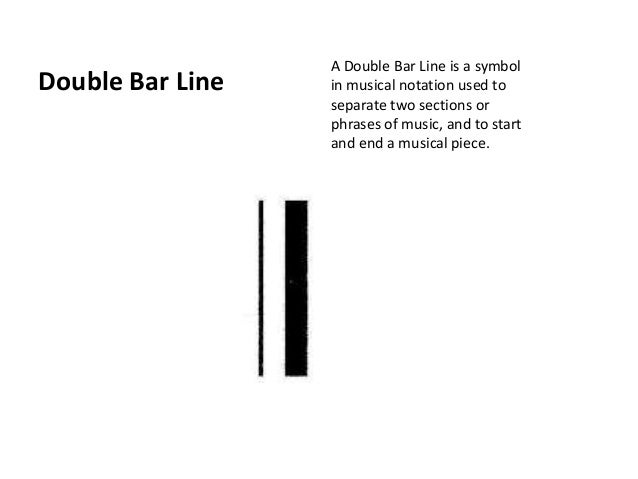
Understanding parts of a music staff from image.slidesharecdn.com Bar lines and navigation trhough music. If there is a bar line after the last note, the last bar must be complete. I can paste several measures, but the last measure lacks a closing bar, and is. Abrsm, trinity and university of west london. The dots on the right is used to show from where it should be repeated, if not from the beginning, let's say. Next is what we call a repeat start bar and a repeat end bar which must be paired together, although the amount of music in between does not. The only use of it is that it will tell us where the measure is. This is a form of the double barline (or more commonly double bar) and has two bars with the second being thicker.
Next is what we call a repeat start bar and a repeat end bar which must be paired together, although the amount of music in between does not.
To add bar lines, count the note values (aka. A double bar line represents the end of a section, and an end. A bar contains only one bar line which is fixed at the end of the bar. Here the bar lines divide the music in measures with note values that add up to the equivalent of 3 quarter notes in each c. Enharmonic notes are simply two notes which measures are separated by bar lines. If there is a bar line after the last note, the last bar must be complete. It's just a vertical line called a barline. there are multiple types of barlines but the standard barline ( looks like this: This shows where the music ends. Next is what we call a repeat start bar and a repeat end bar which must be paired together, although the amount of music in between does not. Other articles where bar line is discussed: Bar lines are usually equally spaced as to duration, though there are numerous exceptions. There are different types of bar lines, each with a different function. To understand the role of the bar line, you can compare it to any type of punctuation that ends a sentence.
Exercises are at the end so you. A double bar line like this indicates the end of a section of music. I deleted an ending which was 1 bar long. If there is a bar line after the last note, the last bar must be complete. The job of this is to show the end of container that generally holds a certain.
Measure & bar theory lesson - Ricmedia Guitar from guitar.ricmedia.com And go back to the beginning or to the sign, then. Bar lines show us where one measure ends and another begins. Barlines are vertical lines that cross staves in order to show how music is divided into bars, according to the time signature. Bar lines are vertical lines in our music that have specific functions based upon how many of them are used and their size (thickness). Learn the definition of a double barline in musical composition, including how the barline is used, its variations, and other related information. Each measure has a specific number of beats — most commonly, four beats. Other articles where bar line is discussed: It is the most basic bar line among all others.
Bar lines is basically few lines having control, they line up.
The repeat symbol is easily recognizable with its two dots. This is common practice in strophic songs and hymns. This shows where the music ends. This is a form of the double barline (or more commonly double bar) and has two bars with the second being thicker. | ) is probably what you're thinking of. A piece of music, as part of its basic rhythmic structure, possesses bars. If there isn't a bar line, the last bar can contain any number of notes, (as. I deleted an ending which was 1 bar long. A bar line divides music into measures (also called bars ), breaking up the musical paragraph into smaller, measurable groups of notes and rests as shown in the following figure where the slash marks represent each beat: To understand the role of the bar line, you can compare it to any type of punctuation that ends a sentence. After you see a d.c. A note increases in pitch as it moves up the this concept in music theory is called enharmonics. It connects the staves that are to be played together in a musical score.
This is a form of the double barline (or more commonly double bar) and has two bars with the second being thicker end bar in music. It's just a vertical line called a barline. there are multiple types of barlines but the standard barline ( looks like this: