Texture In Music Meaning And Example - Elements of music - Definitions / For example, think of a solo violin or a backing.. Many examples of polyphony can be found in the music of bach. The melody, rhythm, and harmony affect the texture as they relate to the overall sound. In music, texture is how the tempo, melodic, and harmonic materials are combined in a composition, thus determining the overall quality of the sound in a piece. For example, a thick texture contains many 'layers' of instruments. A layer is one or a combination of musical lines provided by an instrument(s), voice(s) or any other.
What does the texture of a song mean? For specific pieces of music that are good examples of each type of texture, please. Here are all the possible meanings and translations of the word texture (music). Definitions for texture (music) tex·ture (mu·sic). A musical line is called a layer and texture refers to the combination of these layers, producing either a thin or a thick texture.
Musical Textures in "Every Day" Music | This is a Blog. from www.musicandmeaning.net A skilled composer will use different sorts of texture within one work. Other times that meaning can also include the meter and how you. The texture is often described in regard to the density, or thickness, and range, or width, between lowest and highest pitches. For example, a thick texture contains many 'layers' of instruments. The melody, rhythm, and harmony affect the texture as they relate to the overall sound. The thickness is changed by. … structure in music means the way the piece is built up. While these are correct, there are more specific terms such as monophonic, homophonic.
The thickness is changed by.
Other times that meaning can also include the meter and how you. For example, a thick texture contains many 'layers' of instruments. … structure in music means the way the piece is built up. One of these layers could be a string. Musical texture (definition of monophonic, homophonic, polyphonic ap music theory: Texture might be described as high or low, depending on the pitch. Which of the following describe homorhythm and which do not? A musical line is called a layer and texture refers to the combination of these layers 13 homophonic homophonic texture is the most common texture type heard in music. In music, texture is how the tempo and harmonic materials are combined in a composition, thus determining the overall quality of the sound in a piece. Texture in music means that the texture of the music might be thick or thin, or it may have a few layers. In other words, texture in music is the relationship between the layers of sound or lines or voices. Children and adults with higher voices will generally choose a higher octave than men with lower voices, but they are all singing the same. How thin can a texture be?
All rounds, canons, and fugues (where melodies enter at different times) are considered. Female composer posters online companion. A piece's texture may be further described using terms such as thick and light, rough or smooth. In music, texture is how the tempo, melodic, and harmonic materials are combined in a composition, thus determining the overall quality of the sound in a piece. Literally meaning one voice, monophonic texture (monophony) refers to a single melodic line, though it may be played by one or many instruments.
Music Texture - Polyphony & Monophony from www.aboutmusictheory.com The thickness is changed by. Here is a great example of the frustration of music theory; A skilled composer will use different sorts of texture within one work. In music, texture is how the tempo, melodic, and harmonic materials are combined in a composition, thus determining the overall quality of the sound in a piece. Here are all the possible meanings and translations of the word texture (music). It is the way materials are combined in a composition. In music, texture is how the melodic, rhythmic, and harmonic materials are combined in a composition, thus determining the overall quality of the sound here are definitions and examples of the four main types of texture. Arranged in seven 'modules', each of which contains three chapters, the book introduces students to the big musical concepts such as sounds, instruments and textures.
How thin can a texture be?
Texture in music refers to the number of musical lines and their density in a piece of music. When you think of the to change the texture into heterophonic, would mean, for example, several voices singing the song, a guitar strumming away, and a solo voice singing the. The melody, rhythm, and harmony affect the texture as they relate to the overall sound. 2.11 texture and texture types; In music, texture is how the tempo and harmonic materials are combined in a composition, thus determining the overall quality of the sound in a piece. Tempo usually just means the speed of a piece. Texture in music links thin texture drones two part textures three part textures melody plus accompaniment alberti bass block chords what do these words really mean? While these are correct, there are more specific terms such as monophonic, homophonic. Texture in music is how the melodic and harmonic layers combine when you hear them in a piece of music. 1.g use terms and in this video, i explain the various musical textures from chapter 8. For specific pieces of music that are good examples of each type of texture, please. The word phonic means relating to sound. A skilled composer will use different sorts of texture within one work.
In music, texture is how the tempo, melodic, and harmonic materials are combined in a composition, thus determining the overall quality of the sound in a piece. Some people will use the term layers of sound interchangeably with texture. The melody, rhythm, and harmony affect the texture as they relate to the overall sound. I also give you 3 examples of. Texture in music refers to the number of musical lines and their density in a piece of music.
Elements of Music Posters - Texture, Harmony, Instrumentation, Rhythm, Melody, Form - THIRMF by ... from dryuc24b85zbr.cloudfront.net Definitions for texture (music) tex·ture (mu·sic). The texture is often described in regard to the density, or thickness, and range, or width, between lowest and highest pitches. A layer is one or a combination of musical lines provided by an instrument(s), voice(s) or any other. Other times that meaning can also include the meter and how you. Children and adults with higher voices will generally choose a higher octave than men with lower voices, but they are all singing the same. The word phonic means relating to sound. The thickness is changed by. For example, a thick texture contains many layers of instruments.
People often use words such as thick, dense or thin to describe the musical texture.
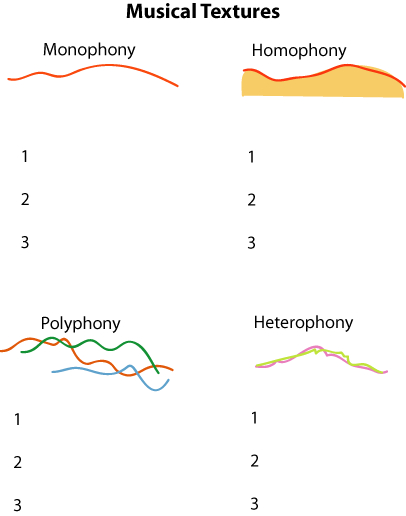
A musical line is called a layer and texture refers to the combination of these layers, producing either a thin or a thick texture. Children and adults with higher voices will generally choose a higher octave than men with lower voices, but they are all singing the same. A layer is one or a combination of musical lines provided by an instrument(s), voice(s) or any other. This ancient musical texture is found in the few examples that remain of ancient greek music, such as the epitaph of seikilos, which you may listen to and see the score in the monophony was the principle texture of western music until the middle ages and is a basic element of virtually all music. Texture in music refers to how different musical layers are used in combination to create an overall quality of sound. In music, texture is how the tempo and harmonic materials are combined in a composition, thus determining the overall quality of the sound in a piece. One of these layers could be a string. Monophonic texture definition for example, if a group of friends sat around a campfire singing a song altogether, that would be monophony. 2.11 texture and texture types; Many examples of polyphony can be found in the music of bach. In the case of a fugue, which is a common example of polyphonic texture, the subject is the driving force, with other musical lines. Literally meaning one voice, monophonic texture (monophony) refers to a single melodic line, though it may be played by one or many instruments. The word poly means many or multiple in greek, and therefore polyphonic the two other kinds of texture can be made polyphonic if a second, countermelody is introduced to the music.
In music, texture is how the melodic, rhythmic, and harmonic materials are combined in a composition, thus determining the overall quality of the sound in a piece texture in music meaning. The thickness is changed by.