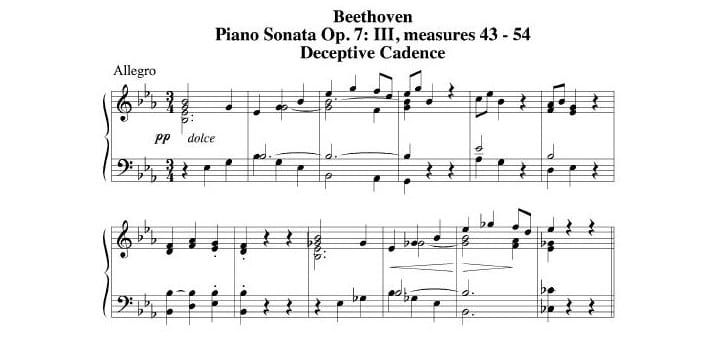
Cadences Music Example / Cadences in Music: Beyond the Harmonic Formulas | School of Composition / Another example might be v to iv or v to ♭vi in a minor key.. By structuring cadences so that the weaker ones come first, the music is apt to feel like it is gradually unfolding and building up (moving) towards a more conclusive goal. For example, in c major a finished cadence would end on the chord c. Whether big or small, the cadence is a sense that the music reached its destination. 3 cadences give phrases a distinctive ending that can, for example, indicate to the listener whether the piece is to be continued or. The cadence in example 3 is relatively strong:
Cadences generally represent a pause in rhythmic, melodic or harmonic movement. A cadence is formed by two chords at the end of a passage of music. Perfect (or authentic) imperfect (or half), plagal and interrupted (or deceptive). Cadences are where the harmony, rhythm, melody and other musical aspects come together to produce a sense of arrival in the music. In the category of authentic cadences are the perfect authentic cadence (pac, for short) and the imperfect authentic cadence (iac).
The Ins and Outs of Cadences for Piano Players from takelessons.com We will differentiate between four basic cadences now, adding more specificity in a later chapter. In the late 1970s and 1980s only a few hit singles made use of andalusian cadences (probably the best known example is sultans of swing by english band dire straits). Multiple recent theories of classical form focus on cadences to define the structural layouts of hadyn, mozart, and beethoven. A cadence can be compared to a comma or period in written language—the ear gets a moment to process a short passage of music, then the music continues. Some authors call this progression a modulating deceptive cadence, or just modulating cadence. For example, many pieces of music begin with notes that are taken from chord i (the tonic chord), followed by notes from chord v (the dominant chord). There are other variations of cadences you can use as punctuations or paragraph endings in your chord progressions. If you have an example that.
In this sense, a period is a macrocosmic example of how scales and progressions operate:
With a little daily practice, you can achieve amazing aural results. Both of the finished cadences sound finished because they end on chord i. Cadences are where the harmony, rhythm, melody and other musical aspects come together to produce a sense of arrival in the music. A deceptive cadence can also resolve in a chord that does not belong to the original key, which would characterize a change in tonality (modulation). However, the 1990s brought about a revival of the progression, mainly with the growing interest in flamenco and latin music (recent examples include 2002 pop hit aserejé a.k.a. Traditional musical structures depend on cadences to give listeners cues about their form. In music, cadences play a crucial role in the organization of musical phrases and sentences.the concept of cadences is applied in a variety of musical forms to facilitate a more coherent perception of a composition, just as punctuation contributes to understanding and correct reading of a written text. The cadence is a critical element in any harmonic progression. Cadences will often come to you naturally without you being aware of them, but understanding how and why you are using them (and how you can avoid using them) will give you more sophisticated control over the dramatic shape and direction of your music. 1 a harmonic cadence is a progression of (at least) two chords that concludes a phrase, section, or piece of music. The following few examples of imperfect cadences include an escape toneas part of the melodic embellishment that leads from scale degree 3 down to 1. Multiple recent theories of classical form focus on cadences to define the structural layouts of hadyn, mozart, and beethoven. For example, many pieces of music begin with notes that are taken from chord i (the tonic chord), followed by notes from chord v (the dominant chord).
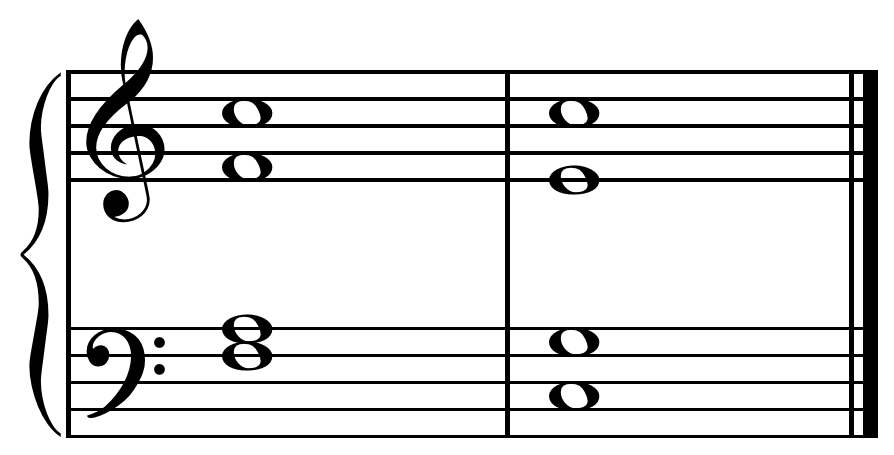
There are four different types of harmonic cadences: Traditional musical structures depend on cadences to give listeners cues about their form. There are other variations of cadences you can use as punctuations or paragraph endings in your chord progressions. You can think of a phrase as a complete musical thought with the cadence being the end of that musical thought. A deceptive cadence is a cadence where the v chord leads to any chord other than a i chord.it appears most commonly as a v to vi.the effect is one of surprise, giving the cadence a unique color and mysteriousness that the other cadences do not have.
Cadences - Music Theory Academy - Perfect, plagal, imperfect, interrupted from www.musictheoryacademy.com The cadence in example 3 is relatively strong: The authentic (or perfect) cadence Female composer posters online companion; 2 a rhythmic cadence is a characteristic rhythmic pattern indicating the end of a phrase. Examples of imperfect cadences imperfect cadences tend to come in the middle of a phrase of music (like a comma comes in the middle of a sentence). These conventions are no longer essential components of music, but there's still a lot to learn about good songwriting if you understand cadences. A deceptive cadence can also resolve in a chord that does not belong to the original key, which would characterize a change in tonality (modulation). However, the 1990s brought about a revival of the progression, mainly with the growing interest in flamenco and latin music (recent examples include 2002 pop hit aserejé a.k.a.
3 cadences give phrases a distinctive ending that can, for example, indicate to the listener whether the piece is to be continued or.
We will differentiate between four basic cadences now, adding more specificity in a later chapter. If you have an example that. For example, in c major a finished cadence would end on the chord c. However, the 1990s brought about a revival of the progression, mainly with the growing interest in flamenco and latin music (recent examples include 2002 pop hit aserejé a.k.a. You can think of a phrase as a complete musical thought with the cadence being the end of that musical thought. Perfect cadences sound as though the music has come to an end. Learn all about the perfect cadence, which chords it uses and how it sounds. With a little daily practice, you can achieve amazing aural results. There are other variations of cadences you can use as punctuations or paragraph endings in your chord progressions. Having a sense of logical motion that works towards an inevitable goal. Cadences will often come to you naturally without you being aware of them, but understanding how and why you are using them (and how you can avoid using them) will give you more sophisticated control over the dramatic shape and direction of your music. Both of the finished cadences sound finished because they end on chord i. Traditional musical structures depend on cadences to give listeners cues about their form.
However, the 1990s brought about a revival of the progression, mainly with the growing interest in flamenco and latin music (recent examples include 2002 pop hit aserejé a.k.a. A cadence is formed by two chords at the end of a passage of music. Do you want to know what a cadence is? Female composer posters online companion; A cadence can be compared to a comma or period in written language—the ear gets a moment to process a short passage of music, then the music continues.
Finish What You Started! Using Cadences in Composition - Soundfly from flypaper.soundfly.com However, the 1990s brought about a revival of the progression, mainly with the growing interest in flamenco and latin music (recent examples include 2002 pop hit aserejé a.k.a. The lesson could not be displayed because javascript is disabled. Do you want to know what a cadence is? 1 a harmonic cadence is a progression of (at least) two chords that concludes a phrase, section, or piece of music. A deceptive cadence is a cadence where the v chord leads to any chord other than a i chord.it appears most commonly as a v to vi.the effect is one of surprise, giving the cadence a unique color and mysteriousness that the other cadences do not have. Whether big or small, the cadence is a sense that the music reached its destination. Traditional musical structures depend on cadences to give listeners cues about their form. The arrival can be a dramatic moment, a simple end of phrase and anything in between.
The cadence in example 3 is relatively strong:
We will differentiate between four basic cadences now, adding more specificity in a later chapter. 2 a rhythmic cadence is a characteristic rhythmic pattern indicating the end of a phrase. In g major, it would finish on a g chord, etc… A deceptive cadence is a cadence where the v chord leads to any chord other than a i chord.it appears most commonly as a v to vi.the effect is one of surprise, giving the cadence a unique color and mysteriousness that the other cadences do not have. Female composer posters online companion; The cadence is a critical element in any harmonic progression. The arrival can be a dramatic moment, a simple end of phrase and anything in between. If you have an example that. Cadences will often come to you naturally without you being aware of them, but understanding how and why you are using them (and how you can avoid using them) will give you more sophisticated control over the dramatic shape and direction of your music. More specifically, do you want to know wh. A deceptive cadence can also resolve in a chord that does not belong to the original key, which would characterize a change in tonality (modulation). In the category of authentic cadences are the perfect authentic cadence (pac, for short) and the imperfect authentic cadence (iac). Some authors call this progression a modulating deceptive cadence, or just modulating cadence.